
Key Takeaways
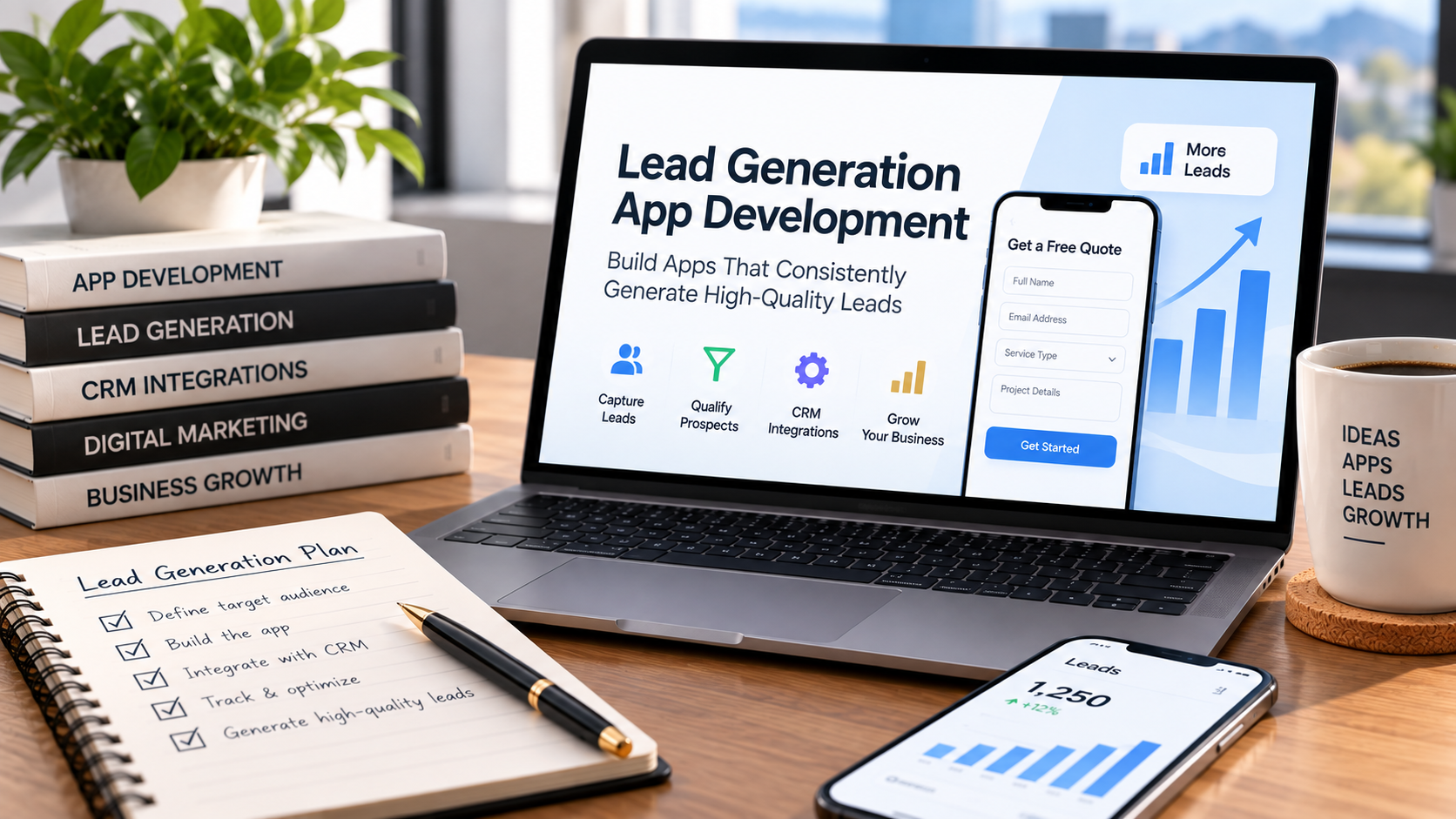
- A lead generation app is a purpose-built tool to capture, qualify, and route leads across web and mobile channels. It is not a generic contact form or brochure site.
- Effective lead gen apps combine focused UX, data tracking, and integrations with CRM systems, Google Ads, email, and SMS to turn traffic and intent signals into sales conversations.
- Dieno Digital builds practical, owned solutions: you keep the code, data, and infrastructure while we connect everything into your digital ecosystem.
- Successful lead gen apps require ongoing optimization around key metrics like lead quality, conversion rate, cost per lead, and speed to lead, not a one-time build.
- These utilities work across sectors (professional services, home services, SaaS, healthcare, education, and more) and plug into existing websites and CRMs.
Introduction: Why Build a Dedicated Lead Generation App in 2026?
Buying journeys have fractured across channels. Potential customers now research via search engines, social media, AI-powered answer tools, referrals, and third-party review sites before they ever fill out a form. They expect responsive, personalized interactions. Blended cost per lead across US industries has climbed to roughly $214 in 2026, with verticals like legal, finance, and higher education exceeding $600 per lead. A static contact page on your website is no longer enough to compete for those buyers.
A lead generation app is a web or mobile application, or a suite of embedded tools, whose primary function is to capture, qualify, and route leads from multiple channels. Think of a home services booking app that collects photos and urgency details, a B2B quote-request portal that asks about budget and timeline, or a cost-calculator mini app for professional services. Each one is built to convert website visitors into actionable pipeline, not just inform them.
This article is a practical guide for founders, marketing leaders, app development companies, and anyone growing an app development business who wants to generate leads more predictably. Dieno Digital has been building lead-gen-focused websites, funnels, and utilities since the mid-2000s, and now extends that experience into app development and AI-powered workflows. Everything we build, you own.
What Is a Lead Generation App? (And How It Differs from a Standard App)
A lead generation app is designed around capturing and converting demand. Its core outcomes are to generate leads, qualify them against defined criteria, capture leads, capture intent signals, and hand prospects to sales or booking systems with minimal friction.
Compare that to a typical marketing website or brochure app: most sites inform; a lead gen app is built to convert and measure. Every screen, every interaction, and every data point feeds back into a system that tells you which channels produce quality leads and which waste budget.
Concrete examples include:
- Industry-specific calculators (cost estimators, ROI tools, eligibility checkers)
- Quote builders that collect key details such as project scope, budget, and timeline
- Appointment booking apps that route requests by service type and location
- Gated resource hubs that capture contact information in exchange for high-value content
- Partner or affiliate referral apps that track lead sources
These apps can be mobile applications for iOS and Android, responsive web apps, or embedded widgets within existing platforms, depending on how your target audience prefers to interact.
Why Lead Generation Apps Matter for App Development Companies and B2B Services
App development firms, digital marketing agencies, and other development services providers—including a mobile app development company—face a specific challenge: their sales cycle is long, their projects involve multiple decision makers, and scoping is complex. Random inquiries from a contact form rarely convert into high-value projects. Lead generation ensures consistent revenue for app development firms by creating a steady stream of pre-qualified opportunities rather than sporadic inbound requests.
Quality leads provide better ROI for high-value app projects because each single lead that matches your ideal customer profile is worth more than a hundred unqualified form fills. Effective lead generation also builds trust and credibility with clients; when your intake process asks informed questions about budget, timeline, and technical requirements, prospects see competence before the first call. Agencies investing in marketing see predictable business growth because the pipeline is fed consistently, not in unpredictable bursts.
Lead generation helps identify businesses seeking app development services by segmenting prospects by project size, industry, whether they operate in the technology industry, technical stack, or urgency. That segmentation reduces time wasted on poor-fit leads and focuses your sales team on conversations likely to close.
Dieno Digital connects your lead gen app into your broader digital ecosystem (website, CRM system, online advertising, analytics) so it becomes a central asset, not a silo.
Core Features of an Effective Lead Generation App
Every lead gen app shares a set of functional building blocks. Here are the ones that separate a high-performing tool from a forgettable form.
Frictionless capture. Multi-step forms outperform long flat forms. Pre-fill known parameters from URL UTMs and ad click metadata to reduce typing. Social sign-in accelerates access. Mobile-first design is non-negotiable: thumb-friendly buttons, minimal text input, and fast load times, especially for forms embedded in ads or landing pages. User friction can be reduced by minimizing form fields during lead capture to only what is needed at each step. Offline functionality is crucial for lead capture in remote areas or industries where field teams operate without consistent connectivity.
Qualification and scoring. Lead scoring helps prioritize high-value prospects. Ask the right questions (budget range, timeline, role, use case) and use simple logic or artificial intelligence to sort warm leads from browsers. Lucidity’s framework outlines six approaches: contact data validation, explicit rules, profile fit, behavior, predictive scoring, and conversation analysis. Lead qualification built into the capture flow produces more sales-ready output than post-form processing.
Integrations. CRM integration allows for seamless lead management and routing. Sync to email tools, SMS platforms, ad platforms, and analytics so no leads are lost and follow-ups are automated.
Engagement features. In-app chat, FAQs, content recommendations, and contextual CTAs help users move from research to action. Chat and contextual prompts can also help generate more leads. Use of dynamic content fosters personalization for better user engagement, showing different offers based on user segment or behavior.
Security and compliance. Data privacy regulations include GDPR, CCPA, and PIPEDA. Lead generation apps require a balance between user experience and data capture; clear opt-in checkboxes and transparent privacy policies are essential for compliance. End-to-end encryption protects user and lead data. Store PII encrypted, transfer all data via HTTPS, and maintain documented consent records.
Designing for Conversion: UX and Flows That Actually Generate Leads
The difference between a lead gen app that produces results and one that collects dust is the UX. Every screen should have one primary conversion goal: book a demo, get a quote, request a callback, or download a guide. Clear CTAs on each screen lead to higher conversion rates.
Progressive profiling is the most effective pattern. Start with essential contact information (name, email, one qualifying question), then ask for extra details later via follow-up screens, emails, or in-app prompts. This keeps the initial form short while still building a complete profile over time.
Social proof matters before the ask. Client testimonials, logos, and key stats (“helping 500+ North American companies since 2005”) build trust before you request sensitive details. Landing pages that include social proof and focused messaging can increase conversion rates by double digits compared to generic pages.
Mobile UX best practices include fast loading speeds, which improve user experience and reduce bounce rates. Optimized form design leads to higher conversion rates on small screens. Error handling should be clear and immediate so users don’t abandon a half-completed flow.
A/B testing helps refine website and app elements for better engagement. Test headlines, CTAs, and form layouts, then feed results into iterative design improvements. Incorporating feedback loops improves user engagement and satisfaction over time, making each version of your app better than the last.
Integrations: Connecting Your Lead Gen App to CRM, Ads, and Analytics
A lead generation app is only as powerful as the systems it talks to. The real value comes from integration across your core lead generation tools.
- CRM: Connect to HubSpot, Salesforce, Zoho, or a simple CRM setup to route leads to your sales team and log activities automatically. Real-time data synchronization is important for lead generation apps so that sales reps see new leads within minutes, not hours.
- Google Ads and paid channels: Pass UTM parameters, keyword data, and campaign IDs into the app and CRM to track what actually converts. Without this, you cannot calculate true cost per lead by channel.
- Email and SMS automation: Tools like Mailchimp, ActiveCampaign, or Twilio trigger nurturing sequences, including email drip campaigns, as soon as a lead is captured. Email marketing nurtures leads and maintains contact over time. Automated nurturing provides timely follow-up content based on user behavior, keeping your brand present during long sales cycles.
- Analytics: Google Analytics 4, dashboards, and custom event tracking make key metrics (conversion rate, cost per lead, speed to lead) visible. Analytics track conversion rates and campaign performance for optimization.
Dieno Digital’s background in marketing technology consulting and systems integration means we design apps as part of a complete lead ecosystem, not standalone projects. Every data point flows from capture to CRM to dashboard.
Capturing and Using Intent Signals Inside Your App
Intent signals are observable behaviors that indicate how close a user is to buying. Examples: a user who completes a cost calculator, watches a full product tour video, or revisits a pricing screen three times in a week is a higher-intent lead than someone who bounced from the homepage.
Your app can log and score these signals, then send them to the CRM to surface the best potential leads and prioritize outreach. A prospect who used your ROI calculator and then viewed case studies gets a call within the hour. A visitor who only skimmed the homepage enters an email drip campaign instead.
Segment-based experiences take this further. Show different CTAs, offers, or messaging to high-intent vs. early-stage users inside the app. High-value prospects see a “book a call” button; early-stage browsers see educational content.
These signals also refine media buying. Feed intent data back into Google Ads, social ads, and SEO strategy to focus budget on the audiences and keywords that produce leads based on real conversion behavior, not just clicks.
Inbound Leads, Outbound Campaigns, and Multi-Channel Funnels
Inbound leads come from SEO, content marketing, referrals, and organic social. Outbound lead generation relies on cold outreach, paid advertising, cold email campaigns, cold email outreach, and contact databases. A lead gen app can serve as the common destination for both, standardizing data and lead qualification criteria across every source.
Multi-channel funnel examples:
- LinkedIn outreach (a top platform for B2B lead generation) that drives to a private calculator app
- Google Ads that send to a booking app with pre-filled campaign data
- Email campaigns that link to a tailored assessment tool
- Meta Ads that allow specific targeting for app development services, directing traffic to a custom intake form
Social media platforms are effective for attracting new clients, and regular posting increases brand presence. Educational posts on social media build trust with potential customers. Webinars can establish authority, showcase advanced features, and attract high-intent leads from both inbound and outbound channels. Coordinated outreach campaigns work best when every channel feeds the same lead-gen flow.
Content marketing is effective for generating leads in app development. Blog posts with targeted keywords attract organic traffic for app developers. High-quality content increases visibility and conversion rates for leads. Content marketing includes blogs, case studies, and FAQs for lead generation. SEO generates targeted traffic for mobile app development companies, and SEO improves website rankings and boosts visibility across search engines.
Avoid channel silos. Consistent messaging and measurement across web, app, email, and ad platforms is what turns marketing efforts into measurable results.
Key Metrics to Track for Lead Generation Apps
Measurement is what separates a vanity app from a real revenue-generating asset. Lead generation apps benefit from continuous measurement and iteration.
Core metrics:
| Metric | What It Tells You |
| Leads generated (count) | Volume from each channel |
| Lead-to-opportunity rate | Percentage that become real sales conversations |
| Opportunity-to-customer rate | True closing effectiveness |
| Cost per lead by channel | Where budget works hardest |
| Speed to lead | Time from capture to first outreach |
Google Ads benchmarks show an average CPC of ~5.42,conversionrateof~8.18%,andaveragecost-per-leadof~66.69 across 23 industries. Your app should beat these numbers for your specific vertical.
Quality-focused metrics include percentage of leads that match your ideal customer profile, average deal size by lead source, and the ratio of closed-won vs. closed-lost by channel. These tell you whether you are attracting the right target market or just generating volume.
Engagement and intent metrics include app sessions per user, feature usage (calculators, booking tools), and completion rates for multi-step flows. Dieno Digital builds dashboards and data visualizations so marketing and leadership teams see, at a glance, which channels and app features produce more business.
Building vs. Buying: Custom Lead Gen Utilities You Actually Own
Off-the-shelf lead gen tools like involve.me can get you started quickly. But they often come with limitations: rigid workflows, per-lead pricing, limited data export, and vendor lock-in that makes switching painful.
Custom lead generation app development gives you full control over UX, data, and integrations. You can reflect your unique offers, pricing logic, and qualification questions. Your lead lists stay in your database. Your scoring rules match your sales process, not a vendor’s template.
Dieno Digital’s approach: we build practical lead-gen utilities and apps that you fully own (code, accounts, infrastructure), designed to plug into your existing stack. Examples of what we have built:
- An internal quote-builder for a B2B service firm that captures project scope, budget, and timeline, then routes qualified leads directly to the right account manager
- A multi-location booking app for a home services company that collects photos, location, and urgency details
- A lead-intake portal for a niche professional practice that pre-qualifies potential clients by case type and jurisdiction
Each of these was built fast using AI-assisted development, keeping costs well below enterprise price tags.
Lead Generation Apps Across Sectors: Practical Use Cases
Lead gen apps are cross-sector tools. The patterns are similar, but the questions, offers, and follow-ups differ by industry.
- Professional services and legal: Consultation request portals with preliminary issue intake, budget ranges, and credentials verification.
- Home services and trades: “Request a quote with photos” apps that route by trade, location, and urgency.
- Healthcare and wellness: New patient intake and appointment booking with insurance eligibility checks.
- Education and training: Program match assessments and cost calculators that capture student profiles and schedule demos.
- SaaS and software development: Interactive ROI calculators, trial-to-paid qualification flows, and demo booking for decision makers.
- Local businesses: Appointment schedulers, loyalty sign-ups, and review-collection tools embedded in existing websites.
Dieno Digital already works with a broad range of North American organizations and can adapt proven lead-gen patterns to new verticals quickly. If you think about your own buying journey, there is almost certainly a point where an app could remove friction or uncertainty for your potential clients.
How Dieno Digital Approaches Lead Generation App Development
Here is how we plan, design, and deliver lead gen apps.
Discovery and strategy. We audit your existing digital ecosystem, map your sales process, interview key stakeholders, and define what a “high quality lead” means for your business. We identify your target audience, your pain points in the current sales funnel, and the customer insights that should drive the app’s logic, while documenting the development process so prospects can see how the app will be planned and delivered.
Design and build. UX flows focus on conversion. Technical architecture supports integrations with your CRM, ad platforms, and analytics. We use AI-assisted development to deliver in weeks, not months, and we keep it affordable. Educational content builds trust and showcases expertise in app development, so we often bake content marketing assets (lead magnets, resource hubs, FAQs) directly into the app.
Implementation and optimization. We wire in analytics, dashboards, A/B testing, and continuous tweaks based on real data from inbound leads and your sales team’s feedback. Well-optimized landing pages help generate quality leads over time as we learn what resonates.
Ownership. Built fast, affordable, and you own the solution. Your code, your accounts, your infrastructure. No lock-in. Tightly integrated with your website, CRM, and online advertising. That is how we deliver app development solutions that support predictable growth.
If you are curious about valuing your own web design business as part of planning your next move, try our free calculator: What Is My Web Design Company Worth?
FAQ
These questions address practical concerns not fully covered above.
How long does it take to build a lead generation app from idea to launch?
Simple lead-gen utilities (like calculators or booking mini apps) can often be scoped, designed, and launched in 4 to 8 weeks. More complex multi-role portals with deep integrations may take 10 to 16 weeks or more. Timelines depend on the number of integrations (CRM, email, payment), required automation, and whether existing brand assets and copy are ready.
Do I need a separate mobile app, or can my lead generation app be web-only?
Most businesses in 2026 can achieve strong results with responsive web apps or embedded lead-gen tools, especially when traffic comes from Google Ads, email, and social links. Native mobile apps make sense when you expect frequent repeat usage, need push notifications, require offline features, or are targeting users who prefer app stores (consumer services, loyalty programs).
Can a lead generation app work with my existing website and CRM?
Yes. Most modern CRMs and websites (WordPress, Shopify, custom stacks) can integrate via APIs, webhooks, or embedded widgets. Dieno Digital specializes in connecting websites, CRMs, and advertising platforms so the lead gen app acts as a seamless extension of your current stack rather than a separate property.
How do I know if my lead generation app is attracting the right decision makers?
The app’s forms and flows should capture role, company size, and use case, enabling you to track how many leads match your ideal customer profile. Review closed-won vs. closed-lost data in your CRM to refine questions, messaging, and targeting so more of your new leads are true decision makers or strong influencers.
What ongoing work is required after the app launches?
Lead Generation App Development: How to Build Apps That Consistently Generate High-Quality Leads
Key Takeaways
- A lead generation app is a purpose-built tool to capture, qualify, and route leads across web and mobile channels. It is not a generic contact form or brochure site.
- Effective lead gen apps combine focused UX, data tracking, and integrations with CRM systems, Google Ads, email, and SMS to turn traffic and intent signals into sales conversations.
- Dieno Digital builds practical, owned solutions: you keep the code, data, and infrastructure while we connect everything into your digital ecosystem.
- Successful lead gen apps require ongoing optimization around key metrics like lead quality, conversion rate, cost per lead, and speed to lead, not a one-time build.
- These utilities work across sectors (professional services, home services, SaaS, healthcare, education, and more) and plug into existing websites and CRMs.
Introduction: Why Build a Dedicated Lead Generation App in 2026?
Buying journeys have fractured across channels. Potential customers now research via search engines, social media, AI-powered answer tools, referrals, and third-party review sites before they ever fill out a form. They expect responsive, personalized interactions. Blended cost per lead across US industries has climbed to roughly $214 in 2026, with verticals like legal, finance, and higher education exceeding $600 per lead. A static contact page on your website is no longer enough to compete for those buyers.
A lead generation app is a web or mobile application, or a suite of embedded tools, whose primary function is to capture, qualify, and route leads from multiple channels. Think of a home services booking app that collects photos and urgency details, a B2B quote-request portal that asks about budget and timeline, or a cost-calculator mini app for professional services. Each one is built to convert visitors into actionable pipeline, not just inform them.
This article is a practical guide for founders, marketing leaders, and app development companies that want to generate leads more predictably. Dieno Digital has been building lead-gen-focused websites, funnels, and utilities since the mid-2000s, and now extends that experience into app development and AI-powered workflows. Everything we build, you own.
What Is a Lead Generation App? (And How It Differs from a Standard App)
A lead generation app is designed around capturing and converting demand. Its core outcomes are to generate leads, qualify them against defined criteria, capture intent signals, and hand prospects to sales or booking systems with minimal friction.
Compare that to a typical marketing website or brochure app: most sites inform; a lead gen app is built to convert and measure. Every screen, every interaction, and every data point feeds back into a system that tells you which channels produce quality leads and which waste budget.
Concrete examples include:
- Industry-specific calculators (cost estimators, ROI tools, eligibility checkers)
- Quote builders that collect project scope, budget, and timeline
- Appointment booking apps that route requests by service type and location
- Gated resource hubs that capture contact information in exchange for high-value content
- Partner or affiliate referral apps that track lead sources
These apps can be mobile applications for iOS and Android, responsive web apps, or embedded widgets within existing platforms, depending on how your target audience prefers to interact.
Why Lead Generation Apps Matter for App Development Companies and B2B Services
App development firms, digital marketing agencies, mobile app development firms, and other development services providers face a specific challenge: their sales cycle is long, their projects involve multiple decision makers, and scoping is complex. Random inquiries from a contact form rarely convert into high-value projects. Lead generation ensures consistent revenue for app development firms by creating a steady stream of pre-qualified opportunities rather than sporadic inbound requests.
Quality leads provide better ROI for high-value app projects because each single lead that matches your ideal customer profile is worth more than a hundred unqualified form fills. Effective lead generation also builds trust and credibility with clients; when your intake process asks informed questions about budget, timeline, and technical requirements, prospects see competence before the first call. Agencies investing in marketing see predictable business growth because the pipeline is fed consistently, not in unpredictable bursts.
Lead generation helps identify businesses seeking app development services by segmenting prospects by project size, industry, technical stack, or urgency. That segmentation reduces time wasted on poor-fit leads and focuses your sales team on conversations likely to close.
Dieno Digital connects your lead gen app into your broader digital ecosystem (website, CRM system, online advertising, analytics) so it becomes a central asset, not a silo.
Core Features of an Effective Lead Generation App
Every lead gen app shares a set of functional building blocks. Here are the ones that separate a high-performing tool from a forgettable form.
Frictionless capture. Multi-step forms outperform long flat forms. Pre-fill known parameters from URL UTMs and ad click metadata to reduce typing. Social sign-in accelerates access. Mobile-first design is non-negotiable: thumb-friendly buttons, minimal text input, and fast load times, especially for forms embedded in ads or landing pages. User friction can be reduced by minimizing form fields during lead capture to only what is needed at each step. Offline functionality is crucial for lead capture in remote areas or industries where field teams operate without consistent connectivity.
Qualification and scoring. Lead scoring helps prioritize high-value prospects. Ask the right questions (budget range, timeline, role, use case) and use simple logic or AI to sort warm leads from browsers. Lucidity’s framework outlines six approaches: contact data validation, explicit rules, profile fit, behavior, predictive scoring, and conversation analysis. Lead qualification built into the capture flow produces more sales-ready output than post-form processing.
Integrations. CRM integration allows for seamless lead management and routing. Sync to email tools, SMS platforms, ad platforms, and analytics so no leads are lost and follow-ups are automated.
Engagement features. In-app chat, FAQs, content recommendations, and contextual CTAs help users move from research to action. Use of dynamic content fosters personalization for better user engagement, showing different offers based on user segment or behavior.
Security and compliance. Data privacy regulations include GDPR, CCPA, and PIPEDA. Lead generation apps require a balance between user experience and data capture; clear opt-in checkboxes and transparent privacy policies are essential for compliance. End-to-end encryption protects user and lead data. Store PII encrypted, transfer all data via HTTPS, and maintain documented consent records.
Designing for Conversion: UX and Flows That Actually Generate Leads
The difference between a lead gen app that produces results and one that collects dust is the UX. Every screen should have one primary conversion goal: book a demo, get a quote, request a callback, or download a guide. Clear CTAs on each screen lead to higher conversion rates.
Progressive profiling is the most effective pattern. Start with essential contact information (name, email, one qualifying question), then ask for extra details later via follow-up screens, emails, or in-app prompts. This keeps the initial form short while still building a complete profile over time.
Social proof matters before the ask. Client testimonials, logos, and key stats (“helping 500+ North American companies since 2005”) build trust before you request sensitive details. Landing pages that include social proof and focused messaging can increase conversion rates by double digits compared to generic pages.
Mobile UX best practices include fast loading speeds, which improve user experience and reduce bounce rates. Optimized form design leads to higher conversion rates on small screens. Error handling should be clear and immediate so users don’t abandon a half-completed flow.
A/B testing helps refine website and app elements for better engagement. Test headlines, CTAs, and form layouts, then feed results into iterative design improvements. Incorporating feedback loops improves user engagement and satisfaction over time, making each version of your app better than the last.
Integrations: Connecting Your Lead Gen App to CRM, Ads, and Analytics
A lead generation app is only as powerful as the systems it talks to. The real value comes from integration.
- CRM: Connect to HubSpot, Salesforce, Zoho, or a simple CRM setup to route leads to your sales team and log activities automatically. Real-time data synchronization is important for lead generation apps so that sales reps see new leads within minutes, not hours.
- Google Ads and paid channels: Pass UTM parameters, keyword data, and campaign IDs into the app and CRM to track what actually converts. Without this, you cannot calculate true cost per lead by channel.
- Email and SMS automation: Tools like Mailchimp, ActiveCampaign, or Twilio trigger nurturing sequences as soon as a lead is captured. Email marketing nurtures leads and maintains contact over time. Automated nurturing provides timely follow-up content based on user behavior, keeping your brand present during long sales cycles.
- Analytics: Google Analytics 4, dashboards, and custom event tracking make key metrics (conversion rate, cost per lead, speed to lead) visible. Analytics track conversion rates and campaign performance for optimization.
Dieno Digital’s background in marketing technology consulting and systems integration means we design apps as part of a complete lead ecosystem, not standalone projects. Every data point flows from capture to CRM to dashboard.
Capturing and Using Intent Signals Inside Your App
Intent signals are observable behaviors that indicate how close a user is to buying. Examples: a user who completes a cost calculator, watches a full product tour video, or revisits a pricing screen three times in a week is a higher-intent lead than someone who bounced from the homepage.
Your app can log and score these signals, then send them to the CRM to prioritize outreach. A prospect who used your ROI calculator and then viewed case studies gets a call within the hour. A visitor who only skimmed the homepage enters an email drip campaign instead.
Segment-based experiences take this further. Show different CTAs, offers, or messaging to high-intent vs. early-stage users inside the app. High-value prospects see a “book a call” button; early-stage browsers see educational content.
These signals also refine media buying. Feed intent data back into Google Ads, social ads, and SEO strategy to focus budget on the audiences and keywords that produce leads based on real conversion behavior, not just clicks.
Inbound Leads, Outbound Campaigns, and Multi-Channel Funnels
Inbound leads come from SEO, content marketing, referrals, and organic social. Outbound lead generation relies on cold outreach, targeted paid ads, cold email campaigns, cold email outreach, and contact databases. A lead gen app can serve as the common destination for both, standardizing data and lead qualification criteria across every source.
Multi-channel funnel examples:
- LinkedIn outreach (a top platform for B2B lead generation) that drives to a private calculator app
- Google Ads that send to a booking app with pre-filled campaign data
- Email campaigns that link to a tailored assessment tool
- Meta Ads that allow specific targeting for app development services, directing traffic to a custom intake form
Social media platforms are effective for attracting new clients, and regular posting increases brand presence. Educational posts on social media build trust with potential customers. Webinars can establish authority and attract high-intent leads from both inbound and outbound channels.
Content marketing is effective for generating leads in app development. Blog posts with targeted keywords attract organic traffic for app developers. High-quality content increases visibility and conversion rates for leads. Content marketing includes blogs, case studies, and FAQs for lead generation. SEO generates targeted traffic for mobile app development companies, and SEO improves website rankings and boosts visibility across search engines.
Avoid channel silos. Consistent messaging and measurement across web, app, email, and ad platforms is what turns marketing efforts into measurable results.
Key Metrics to Track for Lead Generation Apps
Measurement is what separates a vanity app from a real revenue-generating asset. Lead generation apps benefit from continuous measurement and iteration.
Core metrics:
| Metric | What It Tells You |
| Leads generated (count) | Volume from each channel |
| Lead-to-opportunity rate | Percentage that become real sales conversations |
| Opportunity-to-customer rate | True closing effectiveness |
| Cost per lead by channel | Where budget works hardest |
| Speed to lead | Time from capture to first outreach |
Google Ads benchmarks show an average CPC of ~5.42,conversionrateof~8.18%,andaveragecost-per-leadof~66.69 across 23 industries. Your app should beat these numbers for your specific vertical.
Quality-focused metrics include percentage of leads that match your ideal customer profile, average deal size by lead source, and the ratio of closed-won vs. closed-lost by channel. These tell you whether you are attracting the right target market or just generating volume.
Engagement and intent metrics include app sessions per user, feature usage (calculators, booking tools), and completion rates for multi-step flows. Dieno Digital builds dashboards and data visualizations so marketing and leadership teams see, at a glance, which channels and app features produce more business.
Building vs. Buying: Custom Lead Gen Utilities You Actually Own
Off-the-shelf lead gen tools like involve.me can get you started quickly. But they often come with limitations: rigid workflows, per-lead pricing, limited data export, and vendor lock-in that makes switching painful.
Custom lead generation app development gives you full control over UX, data, and integrations. You can reflect your unique offers, pricing logic, and qualification questions. Your lead lists stay in your database. Your scoring rules match your sales process, not a vendor’s template.
Dieno Digital’s approach: we build practical lead-gen utilities and apps that you fully own (code, accounts, infrastructure), designed to plug into your existing stack. Examples of what we have built:
- An internal quote-builder for a B2B service firm that captures project scope, budget, and timeline, then routes qualified leads directly to the right account manager
- A multi-location booking app for a home services company that collects photos, location, and urgency details
- A lead-intake portal for a niche professional practice that pre-qualifies potential clients by case type and jurisdiction
Each of these was built fast using AI-assisted development, keeping costs well below enterprise price tags.
Lead Generation Apps Across Sectors: Practical Use Cases
Lead gen apps are cross-sector tools. The patterns are similar, but the questions, offers, and follow-ups differ by industry.
- Professional services and legal: Consultation request portals with preliminary issue intake, budget ranges, and credentials verification.
- Home services and trades: “Request a quote with photos” apps that route by trade, location, and urgency.
- Healthcare and wellness: New patient intake and appointment booking with insurance eligibility checks.
- Education and training: Program match assessments and cost calculators that capture student profiles and schedule demos.
- SaaS and software development: Interactive ROI calculators, trial-to-paid qualification flows, and demo booking for decision makers.
- Local businesses: Appointment schedulers, loyalty sign-ups, and review-collection tools embedded in existing websites.
Dieno Digital already works with a broad range of North American organizations and can adapt proven lead-gen patterns to new verticals quickly. If you think about your own buying journey, there is almost certainly a point where an app could remove friction or uncertainty for your potential clients.
How Dieno Digital Approaches Lead Generation App Development
Here is how we plan, design, and deliver lead gen apps.
Discovery and strategy. We audit your existing digital ecosystem, map your sales process, interview key stakeholders, and define what a “high quality lead” means for your business. We identify your target audience, your pain points in the current sales funnel, and the customer insights that should drive the app’s logic.
Design and build. UX flows focus on conversion. Technical architecture supports integrations with your CRM, ad platforms, and analytics. We use AI-assisted development to deliver in weeks, not months, and we keep it affordable. Educational content builds trust and showcases expertise in app development, so we often bake content marketing assets (lead magnets, resource hubs, FAQs) directly into the app.
Implementation and optimization. We wire in analytics, dashboards, A/B testing, and continuous tweaks based on real data from inbound leads and your sales team’s feedback. Well-optimized landing pages increase conversion rates over time as we learn what resonates.
Ownership. Built fast, affordable, and you own the solution. Your code, your accounts, your infrastructure. No lock-in. Tightly integrated with your website, CRM, and online advertising. That is how we deliver app development solutions that support predictable growth.
If you are curious about valuing your own web design business as part of planning your next move, try our free calculator: What Is My Web Design Company Worth?
FAQ
These questions address practical concerns not fully covered above.
How long does it take to build a lead generation app from idea to launch?
Simple lead-gen utilities (like calculators or booking mini apps) can often be scoped, designed, and launched in 4 to 8 weeks. More complex multi-role portals with deep integrations may take 10 to 16 weeks or more. Timelines depend on the number of integrations (CRM, email, payment), required automation, and whether existing brand assets and copy are ready.
Do I need a separate mobile app, or can my lead generation app be web-only?
Most businesses in 2026 can achieve strong results with responsive web apps or embedded lead-gen tools, especially when traffic comes from Google Ads, email, and social links. Native mobile apps make sense when you expect frequent repeat usage, need push notifications, require offline features, or are targeting users who prefer app stores (consumer services, loyalty programs).
Can a lead generation app work with my existing website and CRM?
Yes. Most modern CRMs and websites (WordPress, Shopify, custom stacks) can integrate via APIs, webhooks, or embedded widgets. Dieno Digital specializes in connecting websites, CRMs, and advertising platforms so the lead gen app acts as a seamless extension of your current stack rather than a separate property.
How do I know if my lead generation app is attracting the right decision makers?
The app’s forms and flows should capture role, company size, and use case, enabling you to track how many leads match your ideal customer profile. Review closed-won vs. closed-lost data in your CRM to refine questions, messaging, and targeting so more of your new leads are true decision makers or strong influencers.
What ongoing work is required after the app launches?
Post-launch efforts include monitoring key metrics, running A/B tests on copy and CTAs, updating content offers, and adjusting integrations as your tech stack evolves. Dieno Digital typically supports current clients with ongoing SEO, content marketing, online advertising, and technical maintenance so the lead gen app continues to improve over time rather than becoming stale.